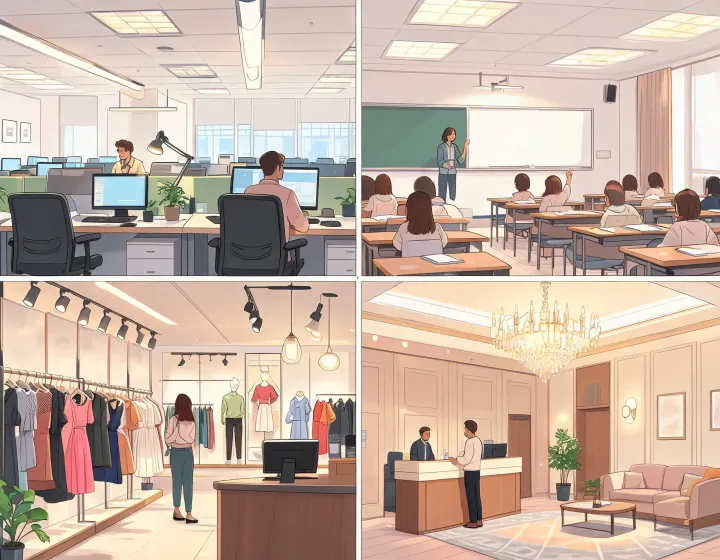
Office and collaboration
Screen work makes glare control, vertical illumination and daylight response central. Review UGR targets alongside luminaire spacing and candela distribution; a nominal high efficacy can still create bright apertures in sensitive sightlines. Typical reviews use the reflected ceiling plan, workstation orientation and a calculation model rather than wattage alone.
- Useful checks
- CCT 3000 K or 4000 K, CRI Ra 80/90+, 0-10V or DALI-2 zoning, occupancy sensing.
Retail and display
Retail layers ambient circulation light with focused merchandise accents. Beam angle, aiming flexibility, spectral power distribution and contrast matter more than uniformity alone. Narrow beams can add drama but may produce sharp shadows or require more careful aiming and maintenance.
- Useful checks
- CRI and TM-30 data, beam options, track compatibility, driver access and relighting plan.
Education
Classrooms need readable boards, comfortable desks and flexible scenes for presentation. Daylight harvesting can reduce input power, while poor sensor placement may cause distracting changes. Commissioning should verify occupied behavior, timeout logic and teacher override rather than accepting factory defaults.
- Useful checks
- Vertical light at teaching surfaces, UGR, control-zone map, emergency lighting coordination.
Healthcare and hospitality
These spaces often prioritize visual comfort, color quality and atmosphere, but their operating patterns differ. Healthcare selection also requires cleaning and access review; hospitality concepts may accept lower ambient levels while using layered accents. Confirm whether an IP rating addresses the actual cleaning process and whether warm dimming is required.
- Useful checks
- CCT consistency, CRI Ra 90+, low-output dimming behavior, service access and local compliance.